

- Inputs are context (exercise, sleep, diet patterns).
- AMPK is a signaling topic in research, not a “fat-loss switch.”
- Outputs are typical pathways discussed — outcomes still depend on the whole system.
- AMPK is studied as part of how cells respond to energy demand, exercise, and nutrient availability.
- Adiponectin is a hormone linked to metabolic markers, but it is not a magic “fat loss switch.”
- Marketing often turns pathway language into guaranteed outcomes. That jump is usually not justified.
- Human outcomes depend on context: sleep, diet pattern, training, baseline health, adherence, and study design.
- The best use of these terms is educational: understanding how claims are framed, not chasing jargon.
Why AMPK and adiponectin appear everywhere
If you spend any time reading about metabolism in 2026, you will see the same pattern: a complicated term is presented as a “switch,” and the reader is told that turning it on guarantees fat loss.
AMPK and adiponectin are two of the most common examples because they are real biology and have a long history in metabolic research. But that also makes them easy to misuse: they sound scientific, and most people do not have time to read the difference between cell models, animal models, observational studies, and randomized trials.
AMPK in plain language
AMPK is commonly described as an “energy sensor.” In very simple terms, AMPK signaling is involved in how cells respond when energy demand increases or energy availability changes.
What AMPK is (conceptually)
- AMPK is a signaling pathway studied in the context of energy balance and metabolic adaptation.
- It is discussed in research about exercise, nutrient availability, mitochondrial function, and stress responses.
- It is not a guarantee that “fat burning will turn on” in a predictable way for every person.
What research usually measures
In academic research, AMPK is not “measured” as a vibe. Researchers measure related markers (phosphorylation status, expression patterns, downstream signaling, etc.), often in controlled settings.
The key problem: controlled measurements do not automatically translate into real-world outcomes like body composition changes, because human outcomes are influenced by many layers of behavior and physiology.
Adiponectin in plain language
Adiponectin is a hormone produced by adipose (fat) tissue. It is often discussed in relation to insulin sensitivity and metabolic health markers.
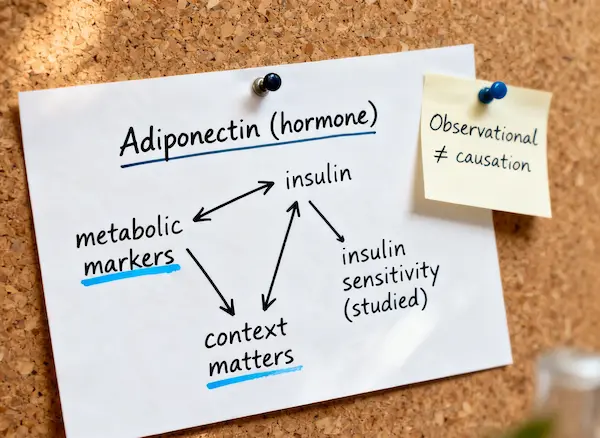
Why adiponectin is interesting
- It shows up in observational research as part of metabolic risk profiles.
- It is often discussed alongside insulin sensitivity, inflammation markers, and cardiometabolic risk.
- It is not a single “switch” that you can reliably force into a fat-loss outcome with one supplement.
What different types of evidence can (and cannot) claim
A major reason metabolism content becomes misleading is that different evidence types get mixed together. Here is the simplest way to interpret claims:

1) Mechanistic (cells / lab models)
Mechanistic research is useful for understanding plausibility. It helps answer “could this pathway be involved?” But it is not a guarantee of real-world outcomes.
2) Animal studies
Animal models can be informative, but metabolism differs across species. Dose scaling, absorption, and behavior context often do not match real human use.
3) Observational studies
Observational research can show correlations: for example, adiponectin levels may correlate with metabolic markers. But correlation is not causation, and confounders (sleep, activity, diet, stress, medication) can dominate.
4) Randomized controlled trials (RCTs)
RCTs are usually the strongest design for outcomes. Even here, you still need to check: sample size, duration, baseline characteristics, adherence, and what outcomes were actually measured.
The most common misinterpretations (2026)
- “Turn on AMPK” is framed as if AMPK is a light switch. Biology is not a light switch.
- Single marker → guaranteed outcome is a leap. Outcomes are multi-factor.
- Ignoring context: sleep, diet pattern, training load, and stress often matter more.
- Timeline hype: aggressive “72-hour” claims are usually marketing signals.
Practical framing (without hype)
The most useful real-world takeaway is not “how to activate AMPK.” The useful takeaway is: repeated lifestyle signals shape metabolic adaptation.
If your goal is metabolic health literacy, a better approach is:
- Understand that energy demand (movement) and recovery (sleep) are core signals.
- Recognize that nutrition is not just “calories,” but also protein, timing, and adherence.
- Be cautious with supplement claims that skip the context layer.
How to read AMPK/adiponectin claims responsibly
- Look for whether the claim is based on human outcomes or lab markers.
- Check whether the outcome measured matches the outcome promised.
- Be skeptical of certainty, especially when timelines are aggressive.
- Prefer content that links to primary sources (PubMed/NIH) or reputable institutions.
Related research on LukeZen
If you are exploring metabolism topics, these pages connect closely with AMPK/adiponectin discussions:
References (primary sources & reputable institutions)
These links are provided for transparent reading. LukeZen is an informational publisher and does not claim affiliation with any institution listed below.
FAQ
Is this page medical advice?
No. LukeZen publishes educational content only. This page does not diagnose, treat, cure, or prevent disease.
Does AMPK automatically mean fat loss?
No. AMPK is a pathway studied in energy regulation. Human outcomes depend on context and are not guaranteed.
Why do supplements claim they “activate AMPK”?
Because it sounds scientific. A compound may influence a marker in a lab model, but marketing often exaggerates the certainty and skips real-world human outcomes.
What matters most for metabolic outcomes in practice?
For most people, consistent signals—sleep, resistance training, diet adherence, and stress regulation—matter more than pathway jargon.
Why are timelines like “72 hours” often misleading?
Because meaningful outcomes usually require time. Aggressive timelines are a common marketing signal, not a reliable evidence signal.
How often should this page be updated?
If the page is used as a pillar, update it at least quarterly (or when major guidelines change) and adjust the “dateModified” field.
Editorial standards
LukeZen Research pages follow a strict neutrality standard: educational tone, no diagnostic claims, no guaranteed outcomes, and transparency-first linking. Learn more on: About, Privacy, and Terms.
Update log
- Feb 2026: Expanded plain-language definitions, added evidence-type separation, added references hub.